
“What It Cost to Explain My Humanity ….“
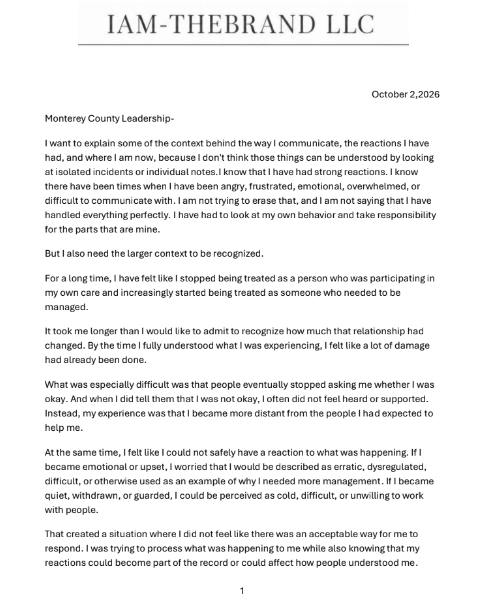
I wrote that letter because I was tired of being reduced to the worst moments of my life.
On paper, it may look like a long explanation, a response, a complaint, a clarification, or maybe even a defense. But that is not what it really was. That letter was the sound of someone trying to put context back into a story that had been flattened.
It was not written because I believe I have handled everything perfectly. I have not. I have had strong reactions. I have been angry. I have been overwhelmed. I have said things from pain. I have had to look at myself and ask what part of the damage was mine to own.
But the part I needed people to understand was this: my reactions did not happen in a vacuum.
What the Letter Really Was
That letter was not just a complaint. It was not only about one incident, one provider, one misunderstanding, or one record. It was a survival document. It was an attempt to put context around the parts of me that had been separated from the story that created them.
It was me saying that accountability matters, but so does context. It was me saying that I can own my reactions without accepting a version of the story where my reactions are treated as if they appeared out of nowhere.
It was also grief. Grief for trust. Grief for the version of recovery I once believed in. Grief for relationships that changed. Grief for the feeling that I had to become careful, documented, and explainable just to be taken seriously.
The Cost
Writing that letter cost more than time. It cost sleep. It cost peace. It cost the energy I needed for school, work, healthcare, housing, and rebuilding my life. It cost the emotional labor of turning pain into language that other people might find acceptable enough to read.
It cost dignity, because there is a particular kind of humiliation in having to explain that you are not just a diagnosis, not just a crisis, not just a difficult interaction, and not just the most alarming note in a file.
It cost money I did not have, hours I could not replace, and strength I was already using to survive. It cost the ability to simply move forward, because every time I had to explain the past, I had to reopen it.
The Hardest Part
The hardest part was not admitting that I had made mistakes. I already knew that. The hardest part was realizing that I could take responsibility and still not be fully seen.
I had to explain that being hurt did not make me irresponsible. I had to explain that being emotional did not make me incapable. I had to explain that needing support did not mean other people owned my recovery.
And I had to explain that wanting autonomy was not the same thing as refusing care. It was the opposite. It was me asking for care that helped me become more capable, not care that made me feel managed.
What I Wanted People to Understand
I wanted people to understand that I am not asking anyone to pretend the hard parts did not happen. I am asking them to stop treating those hard parts as the whole story.
I wanted them to understand that I have fought for my life, my care, my housing, my education, my work, my identity, and my future. I wanted them to see the person who kept showing up, not only the person who broke down.
I wanted them to understand that when a person keeps saying, “I am not okay,” the answer should not only be documentation. It should also be curiosity, conversation, care, and a real attempt to understand what is happening.
What People Assumed About Me
Whatever pre-existing idea people had of me, of what I do, or of how I am, that was not the whole truth. Their assumptions were not evidence. Their opinions were not the full story. And most importantly, they were not there.
They did not know what it was like to be inside that experience. They did not know what I understood, what had been explained to me, what had not been explained to me, or what I believed I was agreeing to at the time. I did not ask anyone to come save me in 2022, and I was not fully aware of the program, the boundaries, the expectations, or the specifications I was being placed into.
That matters, because consent requires understanding. If I did not understand the structure I was being put into, then it is not fair to hold me to an unrealistic version of who people expected me to be inside that structure. By the time I asked to be exited, it felt like my request was interpreted as ingratitude instead of as a sign that something was not working for me.
That is part of why the isolation became so painful. It was not because I had not tried. It was not because I was lazy, unwilling, or refusing to do the work. I tried everything I knew how to try. I asked questions. I looked for answers. I tried to understand the systems around me. I tried to advocate for myself. I tried to build a life while also trying to survive the consequences of not fully understanding what I had been placed inside of.
What I Am Asking For Now
I am asking for the path to be explained clearly. I am asking to know what choices I actually have. I am asking to be allowed to participate in decisions that affect my life.
I am asking not to be reduced to my worst moments. I am asking for my progress to count. I am asking for support that respects my autonomy and does not turn my need for help into proof that I should have less control over my own life.
Closing
That letter was expensive in ways that may never show up on paper. It cost me pieces of myself to write it. But it also gave me something back: a clearer understanding that I am allowed to tell the truth about what happened to me without disappearing inside it.
I am still here. I am still fighting. And I am still trying to build a life that belongs to me.